
A Step-by-Step Guide to Understanding and Using the * operator in Python with Lists
Learn how to multiply or repeat a list n number of times. Understand when and why you would want to do this, along with examples of code snippets that demonstrate it. …
Learn how to multiply or repeat a list n number of times. Understand when and why you would want to do this, along with examples of code snippets that demonstrate it.
Introduction
Multiplying a list in Python is a common operation, especially for beginners just learning the language. The ‘*’ operator can be used as a quick way to repeat or multiply a list multiple times.
It’s important to understand that multiplying lists in Python doesn’t create a new list with copies of each element - instead, it creates an entirely new list which consists of n repetitions of the original list.
This can be very useful for creating patterns in data (like a 5x5 grid filled with ‘a’, or a 3x3 matrix to store coordinates), as well as simple mathematic operations where you want to calculate many things from one number.
Usage
Suppose we have a list my_list = [1, 2, 3]. We can multiply it by an integer n to get another list with length equal to the product of lengths of original lists:
new_list = my_list * n
If you print this new list, you’ll get a total of ‘n’ repetitions of the elements in the original list. For example, if my_list = [1, 2, 3] and n = 3, then new_list would be [1, 2, 3, 1, 2, 3, 1, 2, 3].
Code Snippets
my_list = [1, 2, 3]
n = 3
new_list = my_list * n
print(new_list)
This will print: [1, 2, 3, 1, 2, 3, 1, 2, 3].
Remember to use the code snippets in a Python file or an interactive Python shell for full functionality.
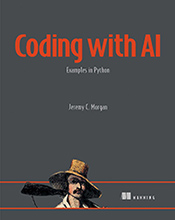
AI Is Changing Software Development. This Is How Pros Use It.
Written for working developers, Coding with AI goes beyond hype to show how AI fits into real production workflows. Learn how to integrate AI into Python projects, avoid hallucinations, refactor safely, generate tests and docs, and reclaim hours of development time—using techniques tested in real-world projects.